Every Salesforce Admin knows this truth:
Bad data in → bad reporting out.
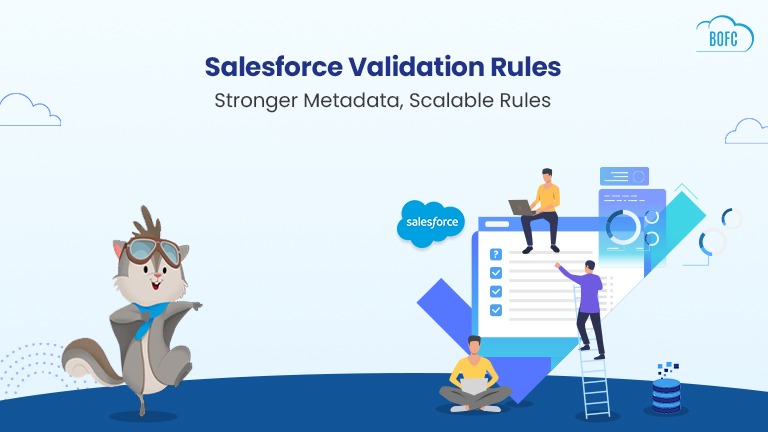
Validation Rules are one of Salesforce’s most powerful native tools for maintaining data quality. They prevent incorrect, incomplete, or non-compliant records from ever entering your system.
But while creating a single validation rule is easy…
Managing dozens (or hundreds) of them across objects, sandboxes, and environments?
That’s where the real challenge begins.
Let’s explore how Validation Rules work — and why bulk management matters more than ever in growing Salesforce orgs.
What Are Validation Rules in Salesforce?
A Validation Rule is a logical condition that Salesforce evaluates before saving a record.
If the condition evaluates to TRUE, Salesforce blocks the save and displays an error message.
Each rule has:
- An error condition formula
- An error message
- An error location (field or page level)
Simple in concept. Essential in practice.
Why Validation Rules Matter
Validation Rules help Salesforce teams:
✔ Maintain data integrity
✔ Enforce business processes
✔ Prevent incomplete records
✔ Reduce manual data cleanup
✔ Improve reporting accuracy
Examples you’ve likely built:
- Require Close Date when Opportunity Stage = Closed Won
- Prevent Case closure without Resolution
- Stop Contacts from saving without Email
- Enforce picklist dependencies
These rules quietly protect your org every day.
The Hidden Admin Challenge: Validation Rules at Scale
As orgs grow, so do:
- Number of objects
- Number of fields
- Number of business conditions
- Number of validation rules
Soon, admins face problems like:
❌ Searching for which object contains a specific rule
❌ Updating the same logic across multiple objects
❌ Auditing validation rules before deployments
❌ Rebuilding rules manually in new environments
❌ Exporting rules for documentation or review
Salesforce’s native UI works fine for one rule at a time.
But modern orgs rarely operate one-at-a-time anymore.
Why Bulk Management Matters
Enterprise Salesforce environments demand:
- Faster configuration changes
- Consistent rule deployment
- Better governance documentation
- Reduced human error
- Easier sandbox-to-prod alignment
When Validation Rules become numerous, manual clicking turns into a real productivity drain.
BOFC Point of View: Treat Validation Rules Like Manageable Metadata
Validation Rules are metadata.
And like all metadata, they deserve bulk visibility, bulk control, and bulk action.
This is where BOFC’s philosophy comes in:
Admins shouldn’t spend hours clicking through Setup screens to manage repetitive metadata tasks.
Instead, metadata — including fields, list views, picklists, record types, and validation rules — should be:
- Exportable
- Auditable
- Bulk editable
- Easy to migrate
- Easy to document
When admins can work with metadata in structured files instead of endless UI screens, governance improves and deployment risks drop dramatically.
A Real-World Example
Imagine preparing a release where:
- 40 new fields are added
- 18 validation rules need updates
- 5 objects require aligned logic
Without bulk tools:
→ Manual edits
→ Risk of missing one rule
→ Longer testing cycles
With a bulk-first metadata approach:
→ One controlled update
→ Faster QA
→ Confident deployment
That’s the future of Salesforce admin work — less clicking, more control.
Best Practices for Validation Rule Governance
Even before tooling, follow these habits:
✅ Use consistent naming conventions
✅ Document rule purpose
✅ Keep formulas readable
✅ Avoid duplicate logic
✅ Regularly audit active rules
✅ Review rules before releases
And when rule volumes grow — adopt bulk-friendly management.
Final Thoughts
Validation Rules are small formulas with massive impact.
They protect your data, enforce your processes, and strengthen user trust.
But as Salesforce orgs scale, managing validation rules manually becomes the real bottleneck.
Smart admins don’t just build rules —
They build systems to manage rules efficiently.