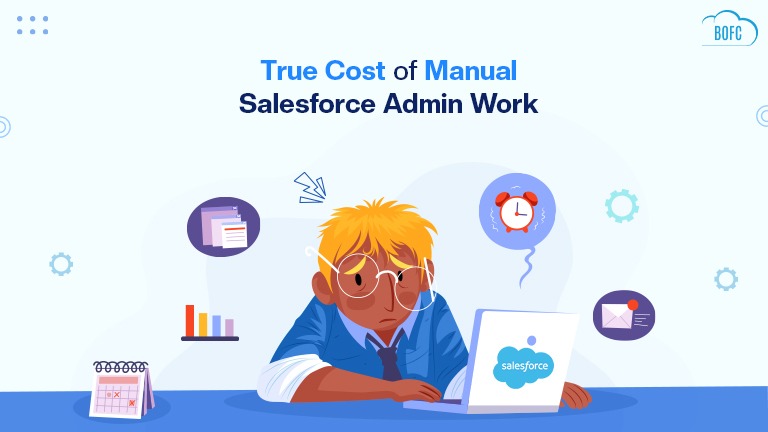
Salesforce is designed to help businesses move faster. But for many Salesforce Admins, manual configuration work does exactly the opposite.
From updating hundreds of fields to cloning metadata between orgs, manual admin tasks quietly drain time, budget, and productivity—often without being tracked.
Let’s break down the real cost of manual Salesforce admin work and how automation can eliminate it.
1. Time Cost: Hours Lost on Repetitive Tasks
A Salesforce Admin’s day often includes tasks like:
- Updating field labels, lengths, help text, or descriptions
- Cloning objects, fields, or picklists
- Comparing metadata between Sandbox and Production
- Exporting field usage or dependencies
- Recreating reports and dashboards across orgs
Using Salesforce’s standard setup, each task requires:
- Opening objects one by one
- Editing fields individually
- Manually validating dependencies
- Repeating the same steps across environments
📉 What should take minutes often takes hours—or days.
2. Cost of Human Errors
Manual work increases the risk of:
- Missing dependent picklist values
- Incorrect field attributes
- Broken automation after deployment
- Inconsistent metadata across orgs
Even a small error can lead to:
- User confusion
- Broken reports or flows
- Rollbacks and rework
- Delayed releases
⚠️ Fixing these issues often costs more time than the original task.
3. Productivity Loss for High-Value Admins
Salesforce Admins are skilled professionals. But manual admin work forces them to spend time on:
- Data entry instead of optimization
- Configuration instead of strategy
- Maintenance instead of innovation
💡 When Admins are stuck doing repetitive tasks, organizations lose the opportunity to:
- Improve user adoption
- Optimize business processes
- Scale Salesforce effectively
4. Hidden Financial Impact
Manual Salesforce work has a direct cost:
- Admin hourly cost × hours spent on repetitive tasks
- Delayed deployments affecting business teams
- Increased dependency on developers or consultants
- Higher long-term maintenance effort
📊 Over a year, these hidden costs can add up to thousands of dollars per org.
5. Why Salesforce Standard Tools Aren’t Enough
Salesforce is powerful—but it’s not optimized for:
- Bulk metadata operations
- Cross-org comparisons
- One-click cloning or exports
- Visibility into dependencies and usage
Admins end up relying on:
- Spreadsheets
- Manual screenshots
- Repetitive setup steps
This is where automation becomes essential.
6. How BOFC Eliminates Manual Salesforce Admin Work
BOFC (Bulk Object Field Creator) is built to remove repetitive admin effort.
With BOFC, Admins can:
- ✅ Bulk create, update, or clone fields
- ✅ Clone objects, reports, dashboards, and picklists
- ✅ Export controlling & dependent picklists in one file
- ✅ Compare metadata across orgs easily
- ✅ Analyze field usage and dependencies
- ✅ Automate tasks that normally take hours
⏱️ Tasks that once took days can be completed in minutes.
7. The ROI of Automation with BOFC
Using BOFC means:
- Faster deployments
- Fewer errors
- Consistent metadata across environments
- Happier Admins and users
- Lower operational costs
📈 Automation doesn’t just save time—it scales Salesforce sustainably.
Final Thoughts
Manual Salesforce admin work is expensive—not just in time, but in lost productivity and business impact. If your Admins are spending hours on repetitive configuration tasks, it’s time to rethink the approach.
BOFC helps you automate, simplify, and take control of Salesforce metadata—without compromising accuracy or speed.
👉 Reduce manual work. Increase efficiency. Scale Salesforce smarter with BOFC.