Coefficient vs BOFC: Which Salesforce Tool Do You Need?
Published: May 18 2026
Last Updated: Oct 07 2026
Salesforce teams today manage far more than just reports. Modern admins are responsible for dashboards, flows, profiles, permission sets, metadata governance, deployments, documentation, and environment consistency.
While Salesforce offers native report cloning capabilities, organizations often require faster and more scalable solutions — especially when managing multiple business teams or Salesforce environments.
Two tools frequently discussed in this space are Coefficient and BOFC.
Although both interact with Salesforce workflows, they solve very different problems.
This guide compares Coefficient vs BOFC based on report cloning, metadata management, automation capabilities, and Salesforce admin productivity.
Why Salesforce Teams Need Report Cloning?
Report cloning helps Salesforce teams:
- Create report variations faster
- Standardize reporting structures
- Reduce repetitive setup work
- Maintain dashboard consistency
- Support sandbox-to-production workflows
- Accelerate reporting operations
For growing Salesforce environments, manual cloning quickly becomes inefficient and difficult to manage at scale.
Understanding the Difference: Data vs Metadata Operations
One of the biggest misunderstandings when comparing Salesforce tools is confusing data operations with metadata operations.
Data Operations
Focused on:
- Salesforce records
- Spreadsheet reporting
- Analytics
- Data synchronization
- Reporting visibility
Metadata Operation
Focused on:
- Salesforce configuration
- Objects and fields
- Picklists and value sets
- Profiles and permission sets
- Flows and workflows
- Dashboards and setup automation
This distinction is important because Coefficient and BOFC serve different operational needs.
What are Coefficient and BOFC?
Coefficient?
Primary Focus
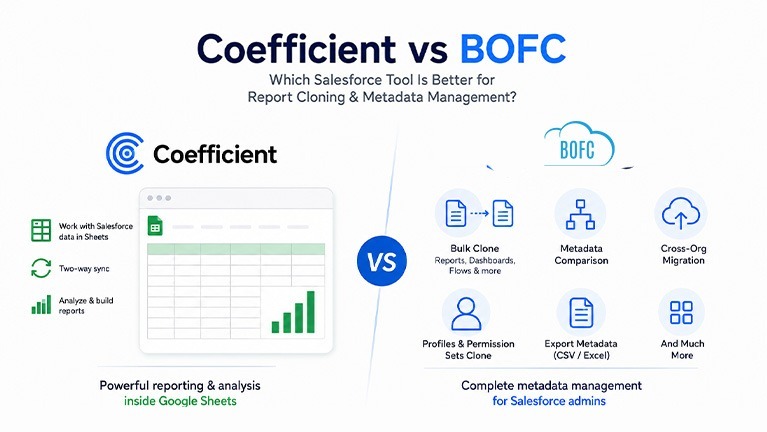
Coefficient is primarily designed for:
- Spreadsheet-based reporting
- Salesforce data synchronization
- Analytics workflows
- Automated spreadsheet refreshes
It is commonly used by operations, reporting, and analytics teams that work heavily inside spreadsheets.
Common Coefficient Use Cases
Teams typically use Coefficient to:
- Sync Salesforce data to Google Sheets or Excel
- Build spreadsheet dashboards
- Automate reporting updates
- Share business metrics
- Create lightweight reporting workflows
Coefficient is highly data-centric.
BOFC?
Primary Focus
BOFC (Bulk Object Field Creator) is designed specifically for Salesforce metadata management and admin automation.
It helps Salesforce Admins perform bulk configuration operations faster and with significantly less manual effort.
Common BOFC Use Cases
Salesforce teams use BOFC for:
- Bulk metadata operations
- Dashboard and component cloning
- Exporting Salesforce metadata
- Managing fields and objects
- Exporting Profiles and Permission Sets
- Picklist and Value Set management
- Flow documentation
- Configuration comparison
- Environment standardization
BOFC is metadata-centric and admin-focused.
Coefficient vs BOFC — Feature Comparison
| Capability | Coefficient | BOFC |
|---|---|---|
| Clone Salesforce Reports | Limited / workflow-based | Supported via metadata workflows |
| Bulk Metadata Operations | Not core focus | Core capability |
| Dashboard Cloning | Limited | Supported |
| Picklist Management | Not available | Supported |
| Metadata Export | Partial | Extensive |
| Flow Documentation | Not available | Supported |
| Salesforce Admin Automation | Limited | Extensive |
| Spreadsheet Reporting | Core capability | Not primary focus |
| Environment Standardization | Limited | Supported |
| Configuration Documentation | Limited | Supported |
Key Differences Between Coefficient and BOFC
1. Purpose and Architecture
Coefficient
Built primarily for:
- Reporting workflows
- Spreadsheet users
- Data collaboration
- Analytics teams
Its strength lies in making Salesforce data easier to consume outside Salesforce.
Built primarily for:
- Salesforce administrators
- Metadata operations
- Bulk configuration tasks
- Setup automation
- Governance and documentation
Its strength lies in reducing repetitive Salesforce admin work.
2. Report Cloning vs Full Configuration Management
Coefficient mainly supports workflows surrounding reports and analytics.
BOFC supports broader Salesforce setup management, including:
- Dashboard cloning
- Picklist cloning
- Field operations
- Metadata exports
- Configuration analysis
- Environment consistency
This becomes especially valuable for large Salesforce implementations.
3. Target Users
Coefficient Best Fits
- Business analysts
- Reporting teams
- Operations teams
- Revenue operations
- Data-focused users
- Salesforce Admins
- Salesforce Consultants
- Implementation partners
- DevOps teams
- Release managers
- System architects
When Should You Use Coefficient?
Coefficient is a strong option if your organization primarily needs:
- Spreadsheet-based reporting
- Salesforce-to-sheet synchronization
- Automated data refreshes
- Analytics collaboration
- Data sharing workflows
It is especially useful for teams already operating heavily in spreadsheets.
When Should You Use BOFC?
BOFC is ideal if your organization needs:
- Bulk metadata management
- Configuration cloning
- Faster admin operations
- Salesforce documentation
- Governance workflows
- Sandbox and production consistency
- Deployment preparation
- Reduced manual setup effort
BOFC is particularly useful for Salesforce admins managing large or rapidly evolving orgs.
Real-World Scenario
Scenario: Replicating a Sales Reporting Structure Across Teams
Using Coefficient
Teams may:
- Sync report data into spreadsheets
- Create analytics dashboards
- Share reporting views externally
- Automate spreadsheet updates
Using BOFC
Admins may:
- Clone dashboard configurations
- Replicate metadata structures
- Standardize environments
- Export setup documentation
- Maintain reporting consistency across orgs
The workflows are complementary but serve different operational layers.
Why Salesforce Admins Prioritize Metadata Automation in 2026
Modern Salesforce environments contain:
- Hundreds of objects
- Thousands of fields
- Complex flows
- Permission structures
- Multiple sandboxes
- Frequent deployments
Manual metadata management no longer scales efficiently.
Salesforce teams increasingly prioritize:
- Bulk operations
- Faster documentation
- Governance automation
- Configuration visibility
- Deployment readiness
- Admin productivity tools
This is where metadata-focused tools like BOFC become increasingly valuable.
Final Comparison: Coefficient vs BOFC
Choose Coefficient If You Need:
- Spreadsheet reporting
- Salesforce data synchronization
- Reporting collaboration
- Analytics automation
- Business reporting workflows
Choose BOFC If You Need:
- Salesforce metadata management
- Bulk configuration operations
- Component cloning
- Environment standardization
- Faster admin workflows
- Metadata exports and documentation
Final Takeaway
Coefficient and BOFC are not direct replacements for each other — they solve different Salesforce challenges.
Coefficient focuses primarily on Salesforce data operations and spreadsheet-based reporting workflows.
For organizations evaluating tools, the right choice depends on whether your primary challenge is:
- Managing Salesforce data and analytics
OR - Managing Salesforce configuration and metadata at scale
Understanding this distinction helps teams invest in tools that align with their operational workflows and long-term Salesforce strategy.